Reviralis ingredients and label
All 40 dietary ingredients as the label prints them, the Daily Values checked, and the limits the blend’s order sets.
The Supplement Facts panel
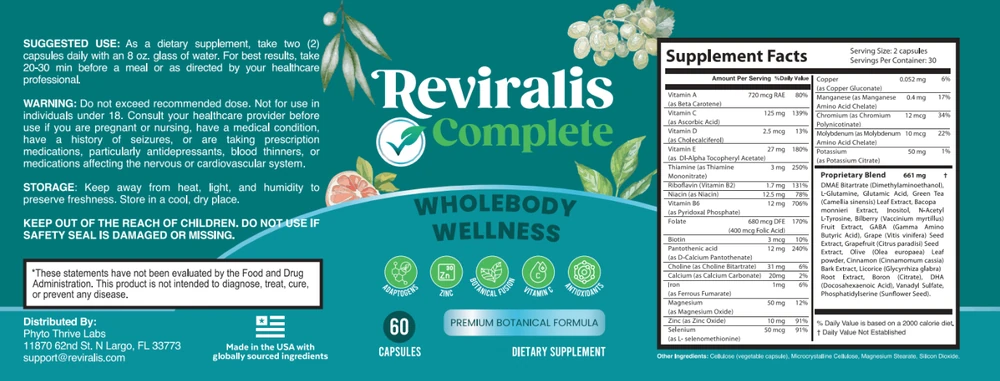
This is the panel as the label artwork prints it, set as text so it can be read on any screen. A serving is 2 capsules; the bottle holds 30 servings.
| Supplement Facts | Amount per serving | % Daily Value |
|---|---|---|
| Vitamin A (as Beta Carotene) | 720 mcg RAE | 80% |
| Vitamin C (as Ascorbic Acid) | 125 mg | 139% |
| Vitamin D (as Cholecalciferol) | 2.5 mcg | 13% |
| Vitamin E (as Dl-Alpha Tocopheryl Acetate) | 27 mg | 180% |
| Thiamine (as Thiamine Mononitrate) | 3 mg | 250% |
| Riboflavin (Vitamin B2) | 1.7 mg | 131% |
| Niacin (as Niacin) | 12.5 mg | 78% |
| Vitamin B6 (as Pyridoxal Phosphate) | 12 mg | 706% |
| Folate | 680 mcg DFE(400 mcg Folic Acid) | 170% |
| Biotin | 3 mcg | 10% |
| Pantothenic acid (as D-Calcium Pantothenate) | 12 mg | 240% |
| Choline (as Choline Bitartrate) | 31 mg | 6% |
| Calcium (as Calcium Carbonate) | 20 mg | 2% |
| Iron (as Ferrous Fumarate) | 1 mg | 6% |
| Magnesium (as Magnesium Oxide) | 50 mg | 12% |
| Zinc (as Zinc Oxide) | 10 mg | 91% |
| Selenium (as L-selenomethionine) | 50 mcg | 91% |
| Copper (as Copper Gluconate) | 0.052 mg | 6% |
| Manganese (as Manganese Amino Acid Chelate) | 0.4 mg | 17% |
| Chromium (as Chromium Polynicotinate) | 12 mcg | 34% |
| Molybdenum (as Molybdenum Amino Acid Chelate) | 10 mcg | 22% |
| Potassium (as Potassium Citrate) | 50 mg | 1% |
| Proprietary Blend | 661 mg | † |
| DMAE Bitartrate (Dimethylaminoethanol), L-Glutamine, Glutamic Acid, Green Tea (Camellia sinensis) Leaf Extract, Bacopa monnieri Extract, Inositol, N-Acetyl L-Tyrosine, Bilberry (Vaccinium myrtillus) Fruit Extract, GABA (Gamma Amino Butyric Acid), Grape (Vitis vinifera) Seed Extract, Grapefruit (Citrus paradisi) Seed Extract, Olive (Olea europaea) Leaf powder, Cinnamon (Cinnamomum cassia) Bark Extract, Licorice (Glycyrrhiza glabra) Root Extract, Boron (Citrate), DHA (Docosahexaenoic Acid), Vanadyl Sulfate, Phosphatidylserine (Sunflower Seed) | ||
How many ingredients, counted
22 vitamins and minerals plus 18 blend ingredients make 40 dietary ingredients on the panel. The brand’s presentation page uses the phrase “41-in-1”; the label is the document that ships with the product, so 40 is the number used throughout this website.
Four more substances are listed as other ingredients. They make and fill the capsule: cellulose (vegetable capsule), microcrystalline cellulose, magnesium stearate, silicon dioxide.
The vitamins and minerals
These 22 lines are the part of the formula you can check, because each has an amount. The FDA publishes the Daily Values that labels must use. We divided every amount on the panel by the matching figure and all 22 printed percentages agree after rounding.
7 lines are at or above 100% of the Daily Value: Vitamin C (139%), Vitamin E (180%), Thiamine (250%), Riboflavin (131%), Vitamin B6 (706%), Folate (170%), Pantothenic acid (240%). At the other end, calcium (2%) and potassium (1%) are small top-ups; the FDA calls 5% or less per serving low and 20% or more high.
A percentage above 100 is not a warning sign in itself, but amounts add up across products. If you already take a multivitamin or a B-complex, compare the two labels. The Journal article on the Daily Value column shows the full calculation.
Vitamin B6 12 mg per serving, 706% of the Daily Value
- The label
- Listed as pyridoxal phosphate. It is the highest percentage on the panel.
- General references
- MedlinePlus describes vitamin B6 as a water-soluble vitamin that, among other things, helps maintain normal nerve function, and lists numbness, sensory changes and difficulty coordinating movement among the effects of large doses.
- Cannot be concluded
- Whether this amount matters for you depends on everything else you take. That is a question for a pharmacist with all your labels in front of them.
The proprietary blend
The second part of the panel is one line: Proprietary Blend, 661 mg, followed by 18 names. A proprietary blend discloses its total weight and its ingredients but not the amount of each one.
The order still carries information. The FDA’s labeling guide requires the ingredients of a blend to be listed in descending order of predominance by weight. An ingredient in position k therefore cannot weigh more than the total divided by k: if it did, the k ingredients at or above it would together exceed the total. The list below applies that rule.
- DMAE bitartrateA salt of dimethylaminoethanol, a compound related to cholineat most 661 mg
- L-glutamineAn amino acidat most 330.5 mg
- Glutamic acidAn amino acidat most 220.3 mg
- Green tea leaf extractAn extract of tea leavesat most 165.2 mg
- Bacopa monnieri extractAn extract of a creeping herb also called water hyssopat most 132.2 mg
- InositolA sugar-like compound found in many foodsat most 110.2 mg
- N-acetyl L-tyrosineA modified form of the amino acid tyrosineat most 94.4 mg
- Bilberry fruit extractAn extract of a dark berry related to the blueberryat most 82.6 mg
- GABAGamma-aminobutyric acid, an amino acid compoundat most 73.4 mg
- Grape seed extractAn extract of grape seedsat most 66.1 mg
- Grapefruit seed extractAn extract of grapefruit seedsat most 60.1 mg
- Olive leaf powderDried, powdered olive leavesat most 55.1 mg
- Cinnamon bark extractAn extract of cassia cinnamon barkat most 50.8 mg
- Licorice root extractAn extract of licorice rootat most 47.2 mg
- BoronA trace element, supplied as boron citrateat most 44.1 mg
- DHADocosahexaenoic acid, an omega-3 fatty acidat most 41.3 mg
- Vanadyl sulfateA compound of the trace element vanadiumat most 38.9 mg
- PhosphatidylserineA phospholipid, sourced from sunflower seedat most 36.7 mg
These are upper limits from arithmetic, per serving of two capsules. They are not the actual amounts, which only the manufacturer knows. An even split would be about 36.7 mg each; the real distribution is unknown.
Four blend ingredients, read with care
For most of the blend we found no government reference page that we could read in full and cite responsibly, so we describe those ingredients only by what they are. For the four below there is one, and each is worth a paragraph because it bears on who should ask a professional first.
Green tea leaf extract position 4, at most 165.2 mg
- The label
- Listed as Green Tea (Camellia sinensis) Leaf Extract. No caffeine figure and no “decaffeinated” wording.
- General references
- NCCIH notes that green tea contains caffeine and that, although uncommon, liver injury has been reported in some people who used green tea products, primarily extracts in tablet or capsule form.
- Cannot be concluded
- How much extract, catechins or caffeine a serving of Reviralis contains. The ceiling above is for the whole extract.
Cinnamon bark extract position 13, at most 50.8 mg
- The label
- Listed as Cinnamon (Cinnamomum cassia) Bark Extract, which is cassia cinnamon rather than Ceylon cinnamon.
- General references
- NCCIH explains that cassia cinnamon contains coumarin; ordinary amounts do not usually cause problems, but prolonged use could be an issue for sensitive people, such as those with liver disease.
- Cannot be concluded
- The coumarin content of this extract. The label does not state it.
Licorice root extract position 14, at most 47.2 mg
- The label
- Listed as Licorice (Glycyrrhiza glabra) Root Extract. The label does not say whether it is deglycyrrhizinated.
- General references
- NCCIH says glycyrrhizin, a component of licorice, can cause serious adverse effects when consumed in large amounts or long term, and that even small amounts have been linked to severe effects in people who eat a lot of salt or who have hypertension or heart or kidney conditions. It also reports interactions with corticosteroids.
- Cannot be concluded
- How much glycyrrhizin a serving contains. If you have high blood pressure or a heart or kidney condition, ask before use.
The other fourteen amino acids, plant extracts and trace compounds
- The label
- DMAE bitartrate, L-glutamine, glutamic acid, bacopa, inositol, N-acetyl L-tyrosine, bilberry fruit, GABA, grape seed, grapefruit seed, olive leaf powder, boron, DHA, vanadyl sulfate and phosphatidylserine from sunflower seed.
- General references
- NCCIH’s guide to using supplements wisely points out that strong evidence for supplement claims is often lacking, that “natural” does not always mean safe, and that supplements can interact with medicines.
- Cannot be concluded
- Any effect of these ingredients at the unstated amounts in this blend. We make no claim for them.
Allergens, capsule shell and storage
The label carries no allergen statement. The capsule shell is vegetable cellulose and the phosphatidylserine is marked as sunflower-derived. The source of the DHA is not stated, and the label makes no vegetarian, vegan or gluten-free claim; ask [email protected] if you need a definite answer.
Storage is one sentence: keep away from heat, light and humidity to preserve freshness, in a cool, dry place. Keep out of the reach of children, and do not use the product if the safety seal is damaged or missing.
What the label asks you to check first
- Do not exceed the recommended dose of two capsules daily.
- Not for use in individuals under 18.
- Consult your healthcare provider before use if you are pregnant or nursing, have a medical condition or have a history of seizures.
- Consult them too if you take prescription medications, particularly antidepressants, blood thinners, or medications affecting the nervous or cardiovascular system.
Sources
- Product source: the Reviralis brand page and its label artwork, the seller’s refund, shipping and contact pages, and the BuyGoods checkout, read on November 23, 2026.
- General reference: U.S. Food and Drug Administration. Dietary Supplement Labeling Guide: Chapter IV. Nutrition Labeling.
- General reference: U.S. Food and Drug Administration. Daily Value on the Nutrition and Supplement Facts Labels.
- General reference: MedlinePlus Medical Encyclopedia. Vitamin B6.
- General reference: National Center for Complementary and Integrative Health. Green Tea: Usefulness and Safety.
- General reference: National Center for Complementary and Integrative Health. Cinnamon: Usefulness and Safety.
- General reference: National Center for Complementary and Integrative Health. Licorice Root: Usefulness and Safety.
- General reference: National Center for Complementary and Integrative Health. Using Dietary Supplements Wisely.
- Our own arithmetic: totals, cost per day, Daily Value checks, blend ceilings and pack comparisons are calculated from the label and the prices above.