What the column is for
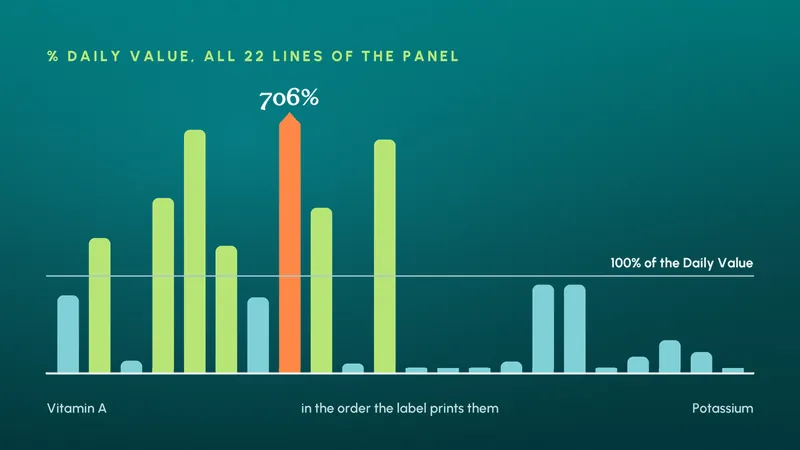
The right-hand column of a Supplement Facts panel answers one question: how much of a day’s reference amount does one serving provide? The reference amounts are the Daily Values, which the FDA sets for use on labels. They are the same for every product, which is what makes two labels comparable.
The FDA’s rule of thumb is short: 5% or less of the Daily Value per serving is low, 20% or more is high.
Checking the label’s arithmetic
A percentage on a label is a claim you can test. Take the amount, divide by the Daily Value, multiply by 100, round to a whole number. We did that for all 22 vitamin and mineral lines on the Reviralis panel.
| Nutrient | Label amount | FDA Daily Value | Amount ÷ Daily Value | Label prints |
|---|---|---|---|---|
| Vitamin A | 720 mcg RAE | 900 mcg RAE | 80.0% | 80% |
| Vitamin C | 125 mg | 90 mg | 138.9% | 139% |
| Vitamin D | 2.5 mcg | 20 mcg | 12.5% | 13% |
| Vitamin E | 27 mg | 15 mg | 180.0% | 180% |
| Thiamine | 3 mg | 1.2 mg | 250.0% | 250% |
| Riboflavin | 1.7 mg | 1.3 mg | 130.8% | 131% |
| Niacin | 12.5 mg | 16 mg | 78.1% | 78% |
| Vitamin B6 | 12 mg | 1.7 mg | 705.9% | 706% |
| Folate | 680 mcg DFE | 400 mcg DFE | 170.0% | 170% |
| Biotin | 3 mcg | 30 mcg | 10.0% | 10% |
| Pantothenic acid | 12 mg | 5 mg | 240.0% | 240% |
| Choline | 31 mg | 550 mg | 5.6% | 6% |
| Calcium | 20 mg | 1,300 mg | 1.5% | 2% |
| Iron | 1 mg | 18 mg | 5.6% | 6% |
| Magnesium | 50 mg | 420 mg | 11.9% | 12% |
| Zinc | 10 mg | 11 mg | 90.9% | 91% |
| Selenium | 50 mcg | 55 mcg | 90.9% | 91% |
| Copper | 0.052 mg | 0.9 mg | 5.8% | 6% |
| Manganese | 0.4 mg | 2.3 mg | 17.4% | 17% |
| Chromium | 12 mcg | 35 mcg | 34.3% | 34% |
| Molybdenum | 10 mcg | 45 mcg | 22.2% | 22% |
| Potassium | 50 mg | 4,700 mg | 1.1% | 1% |
Swipe sideways to see every column.
All 22 agree. Vitamin B6 is a good example: 12 mg divided by a Daily Value of 1.7 mg is 705.9%, printed as 706%. Potassium is the smallest: 50 mg against 4,700 mg is 1.1%, printed as 1%.
That agreement does not prove what is inside a capsule. It shows that the panel is internally consistent and uses the current Daily Values, which is the part of a label a reader can verify from a desk.
Reading the shape of the formula
Sorted by the FDA’s rule of thumb, the panel has 13 lines that count as high (20% or more), of which 7 reach 100% or more, and 2 that count as low (5% or less).
The lines at or above 100% are vitamin C (139%), vitamin E (180%), thiamine (250%), riboflavin (131%), vitamin B6 (706%), folate (170%), pantothenic acid (240%). The B vitamins dominate that group. The minerals are mostly modest: zinc and selenium at 91% each are the exceptions, while calcium, potassium, iron, copper and choline are small top-ups.
Above 100% is not automatically a problem, or a benefit
A Daily Value is a reference point for labels, not a ceiling. Many supplements provide more than 100% of some vitamins. It is also not a target that more is better than: a higher percentage means a larger amount, nothing else.
What matters in practice is the total across everything you take. MedlinePlus lists numbness, sensory changes and difficulty coordinating movement among the effects of large doses of vitamin B6. This label provides 12 mg a day. If you also take a multivitamin, a B-complex or an energy product, add the B6 lines together and show the sum to a pharmacist.
What the column cannot do
- It says nothing about the proprietary blend. Those 18 ingredients carry a dagger, meaning no Daily Value is established, and no individual amounts.
- It is based on a 2,000 calorie diet for adults and children aged four and over; individual needs differ.
- It does not tell you how well a given form is absorbed. The panel names the forms, such as magnesium oxide or zinc oxide, but a percentage treats all forms alike.
- It is not a statement about health effects. The label’s own claims carry the FDA disclaimer.
A three-minute check for any label
Find the serving size
Every amount is per serving. Here that is 2 capsules, not one.
Pick three lines and divide
Amount divided by Daily Value. If your result is far from the printed percentage, something on the label is off.
Mark what is high and what is low
20% or more, 5% or less. That tells you what the product is really built around.
Add your other products
Line up the same nutrient across every supplement you take and total it before you ask a professional.
Sources
- Product source: the Reviralis brand page and its label artwork, the seller’s refund, shipping and contact pages, and the BuyGoods checkout, read on November 23, 2026.
- General reference: U.S. Food and Drug Administration. Daily Value on the Nutrition and Supplement Facts Labels.
- General reference: MedlinePlus Medical Encyclopedia. Vitamin B6.
- General reference: U.S. Food and Drug Administration. Dietary Supplement Labeling Guide: Chapter IV. Nutrition Labeling.
- Our own arithmetic: totals, cost per day, Daily Value checks, blend ceilings and pack comparisons are calculated from the label and the prices above.