What a proprietary blend discloses
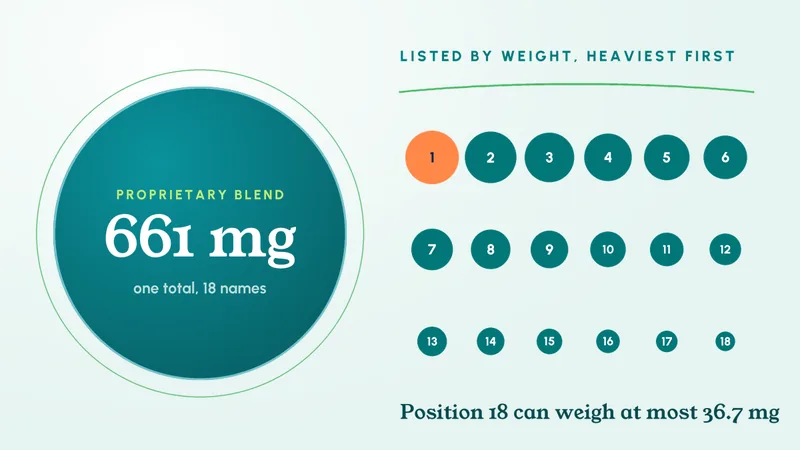
The second half of the Reviralis panel is a single line: Proprietary Blend, 661 mg, with a dagger for “Daily Value not established”, followed by 18 ingredient names.
That format is allowed. The FDA’s labeling guide says a blend must be identified as such, must state the total weight of its ingredients, and must list them in descending order of predominance by weight. It does not have to state how much of each one there is.
The one rule that turns order into numbers
Descending order means each ingredient weighs at least as much as the one after it. Follow that through and you get a ceiling for every position.
Take the ingredient in position k. The k ingredients from the top of the list down to it each weigh at least as much as it does. Together they cannot weigh more than the whole blend. So k times its weight is at most 661 mg, and its weight is at most 661 divided by k.
| Position | Ingredient | At most (mg per serving) |
|---|---|---|
| 1 | DMAE bitartrate | 661 |
| 2 | L-glutamine | 330.5 |
| 3 | Glutamic acid | 220.3 |
| 4 | Green tea leaf extract | 165.2 |
| 5 | Bacopa monnieri extract | 132.2 |
| 6 | Inositol | 110.2 |
| 7 | N-acetyl L-tyrosine | 94.4 |
| 8 | Bilberry fruit extract | 82.6 |
| 9 | GABA | 73.4 |
| 10 | Grape seed extract | 66.1 |
| 11 | Grapefruit seed extract | 60.1 |
| 12 | Olive leaf powder | 55.1 |
| 13 | Cinnamon bark extract | 50.8 |
| 14 | Licorice root extract | 47.2 |
| 15 | Boron | 44.1 |
| 16 | DHA | 41.3 |
| 17 | Vanadyl sulfate | 38.9 |
| 18 | Phosphatidylserine | 36.7 |
What the ceilings tell you
DMAE bitartrate, in first place, could in principle be almost the whole blend. Phosphatidylserine, in last place, cannot exceed 36.7 mg per serving, and each capsule holds half a serving. The eight plant extracts and powders sit between positions 4 and 14, so none of them can exceed 165.2 mg and the later ones are capped well below that.
Per bottle the whole blend weighs 19.83 g (661 mg times 30 servings). Whatever the split, that is the total amount of all 18 ingredients you receive in a month.
What they cannot tell you
- The actual amounts. A ceiling is the most an ingredient could weigh, and the true figure may be far lower.
- An even split. 661 mg shared equally would be about 36.7 mg each, but nothing says the blend is shared equally, and descending order suggests it is not.
- The strength of an extract. “Green tea leaf extract” does not say how concentrated it is or how much caffeine it carries.
- Whether an amount matches what was used in research on that ingredient. Without the amount, that comparison cannot be made, in either direction.
Why this matters for a few names on the list
For most of the blend the ceilings are a curiosity. For three ingredients they are useful context, because general references attach cautions to them. Green tea leaf extract is at most 165.2 mg per serving; NCCIH notes that green tea extracts in tablet or capsule form have, uncommonly, been linked to liver injury. Cassia cinnamon bark extract is at most 50.8 mg; NCCIH explains its coumarin content. Licorice root extract is at most 47.2 mg; NCCIH describes the effects of glycyrrhizin.
A ceiling does not make an ingredient safe or unsafe for you. It gives a doctor or pharmacist a number to reason with where the label gives none.
Questions worth asking the seller
- How much caffeine does a serving contain, and is the green tea extract decaffeinated?
- Is the licorice extract deglycyrrhizinated?
- What is the source of the DHA?
- Is a certificate of analysis available for the current lot?
Product support is at [email protected]. We put the label’s facts on this site; answers to these questions would have to come from the company.
Sources
- Product source: the Reviralis brand page and its label artwork, the seller’s refund, shipping and contact pages, and the BuyGoods checkout, read on November 23, 2026.
- General reference: U.S. Food and Drug Administration. Dietary Supplement Labeling Guide: Chapter IV. Nutrition Labeling.
- General reference: National Center for Complementary and Integrative Health. Green Tea: Usefulness and Safety.
- General reference: National Center for Complementary and Integrative Health. Cinnamon: Usefulness and Safety.
- General reference: National Center for Complementary and Integrative Health. Licorice Root: Usefulness and Safety.
- Our own arithmetic: totals, cost per day, Daily Value checks, blend ceilings and pack comparisons are calculated from the label and the prices above.